

December 30, 2025
WHY THE UNITED STATES DOESN'T HAVE HIGH-SPEED RAIL
In 1965, the High-Speed Ground Transportation Act was enthusiastically passed by Congress to set the United States on a path to lead the world in rail transportation. Instead, European and Asian countries led the way, while the United States created one line, the Metroliner, between New York City and Washington, DC, which was discontinued in 2006. Several reasons are typically given to explain the difficulty in creating a high-speed rail network, primarily outdated tracks, lack of funds, lack of will, and the sheer size of the country. But there may be a clearer hindrance to its development: capitalism.
Humanity spent hundreds of years developing innovative ways to move heavy objects more easily. The first, and oldest continuously operating, railway was created in England in 1758. It was established to transport coal to the city of Leeds. The first North American railway was built six years later in New York to move military supplies around Niagara Falls. The first commercial railway was constructed in Pennsylvania in 1809 to transport stones from a quarry near Philadelphia. Metal tracks and steam-powered trains were soon invented, and by the 1830s, the United States had the longest system of steam railways in the world. All of these developments were created primarily to move freight.
On Christmas Day in 1830, the first passenger steam locomotive carried people six miles from Charleston to Branchville. By the time the first transcontinental railroad was completed in 1869, rail had become the undisputed preferred method of long-distance transportation. In the 1920s, the emergence of automobiles and airplanes began to change that. By the late 1900s, several rail company bankruptcies led to the federal government creating Amtrak and taking control of all intercity passenger rail travel in 1971.
FREIGHT AND PASSENGER TRAFFIC IN BILLIONS OF MILES
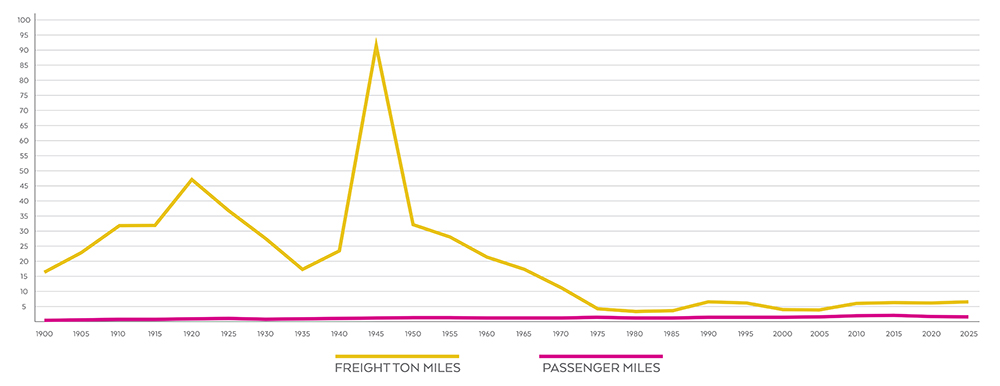
That story is repeated in almost every account of United States transportation history, and while the details are true, it ignores some key data. As railroads developed in the United States, several short passenger lines were attempted, but none proved to be profitable. Every sustained railroad company operated both freight and passenger service, every railroad tycoon despised passenger service because it was less profitable, and every railroad company propped up its passenger service with its freight profits. That can be seen in the comparisons of freight miles and passenger miles throughout the twentieth century. Most historians consider 1920 the pinnacle of the US passenger rail industry with over 40 million passengers transported that year. But that year was outpaced 160 times over by the rail freight industry. Last year saw the highest passenger rail statistics in US history at almost 2 billion passenger miles, and one of the lowest freight years, and freight was still three times greater than passenger traffic.
REVENUE IN BILLIONS OF DOLLARS
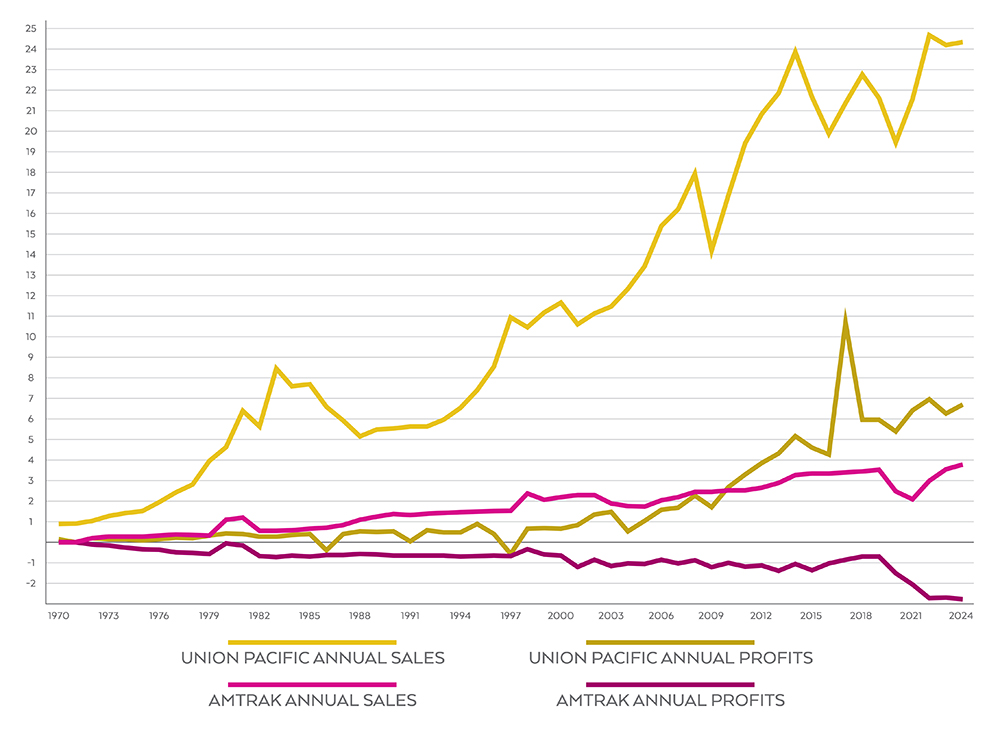
Further data comparisons reveal a clearer picture of the vast difference between freight and passenger rail as a business. Union Pacific is both the oldest and largest publicly traded freight rail company in the United States. In the past 55 years, both Union Pacific and Amtrak increased their revenues by over 2000%, although Union Pacific has over $20 billion more in annual revenue. During that same time, Union Pacific has increased its profits by over 8000%, netting almost $7 billion last year. Amtrak has failed to post a profit every year since its inception, losing over $46 billion thus far.
The United States rail system was built by and serves the freight industry. Passengers were always an inconvenient and unprofitable necessity. This is true today for passenger railways all over the world, which we will highlight in our next episode. The average profitability of the top 130 rail systems in the world is a 30% loss.
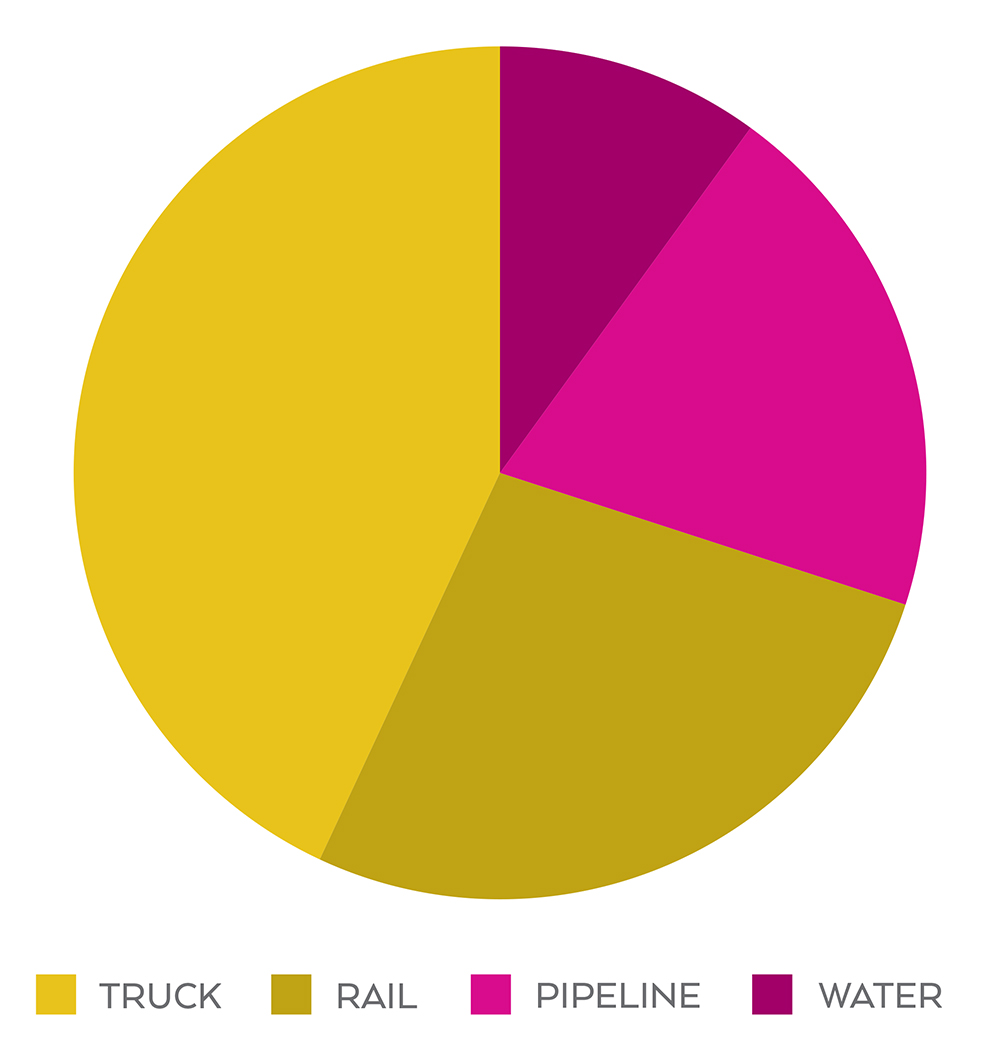
In 2024, Amtrak served about 30 million passengers. That put the United States behind 41 other countries in passenger volume. That same year, the United States moved 1.7 billion tons of freight via rail, second only to China. For all the criticisms of its train system, the United States has the largest rail system in the world, almost 40,000 miles more tracks than the second largest country, China. In 2023, railroads in the United States transported about 1.5 billion tons of freight, almost 30% of all freight in the country, second only to truck transportation.
US FREIGHT TRANSPORTATION BREAKDOWN
The following quote from the Federal Railroad Administration website best summarizes the state of high-speed rail in the United States, keeping in mind that, according to international definitions, the US does not currently possess one mile of high-speed rail. "Since 1964, the United States has been exploring the notion of high-speed rail transportation - around the time Japan built the first Shinkansen line and before any of the European countries built their high-speed rail lines. The reverse chronology below summarizes the Federal policy and fiscal investments towards making this efficient transportation alternative a reality." Over 60 years later, that reality is still a fantasy, because the reality is: moving freight makes way more money than moving people.
SOURCES
- "After a Slow Start, High-Speed Rail Might Finally Arrive in America" from The New York Times
- "Why High-Speed Bullet Trains Won’t Work in the U.S. Right Now" from Scientific American
- "Why Can't America Have High-speed Rail? Because Our Investment is a 'Rounding Error' Compared with Europe's, Says Amtrak's CEO" from Fortune
- "Middleton Railway" from the Middleton Railway Trust
- "The Beginnings of American Railroads and Mapping" from the Library of Congress
- "The Best Friend of Charleston: Short-Lived, Long Legacy" from South Carolina State Museum
- "Is This Any Way To Ruin A Railroad?" from American Heritage
- "Railroad Passengers Carried One Mile for United States" from the United States Federal Reserve
- Passenger Car-Miles, Class I Railroads for United States" from the United States Federal Reserve
- "Passenger-Miles Per Car-Mile, Class I Railroads for United States" from the United States Federal Reserve
- "Class I Railroad System Mileage and Ton-miles of Freight: 1970-2015" from United States Bureau of Transportation Statistics
- "An Introduction to Class I Freight Railroads" from Railinc
- "Farebox Recovery Ratio" from Wikipedia
- "Railway Statistics 2014 Synopsis" from International Union of Railways
- "Railroads by Country 2025" from World Population Review
- "U.S. Ton-Miles of Freight" from United States Bureau of Transportation Statistics
- "High-Speed Rail Timeline" from the Federal Railroad Administration
- Revenue data from Union Pacific and Amtrak annual reports
LISTEN

SUBSCRIBE


