
June 30, 2025
PEPSI LOOKS MORE LIKE NUMBER ONE
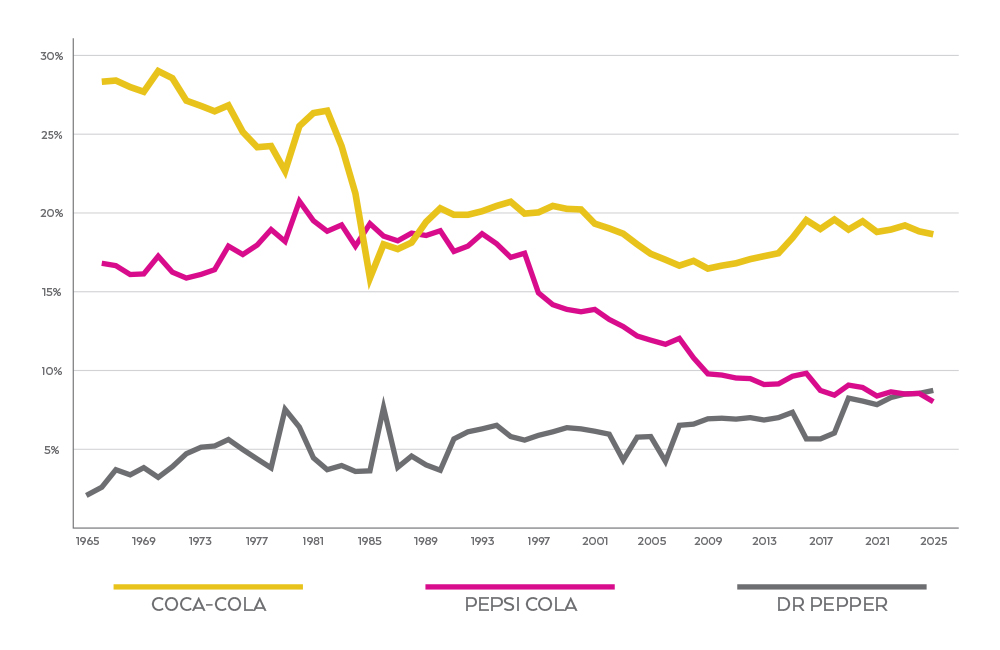
Last year, the beverage industry was rocked by a move that many thought was an impossibility. After decades of the iconic "cola wars" between soda giants Coke and Pepsi, Dr Pepper actually surpassed Pepsi to become the second most popular soda in the United States. Pepsi has trailed behind Coke for most of the two brands' histories. From 1985 to 1989, Pepsi was briefly the number one soft drink after Coca-Cola's New Coke debacle. But looking at the data visually, it is clear that Pepsi peaked in popularity in 1980 and has been declining ever since. Multiple media outlets covered the story with various speculations on what the news means for the future of Pepsi. But to understand Pepsi's future, we have to look at Pepsi's past.
MARKET SHARE IN THE UNITED STATES
The invention of carbonated water is credited to English chemist Joseph Priestley in 1767. The first official soda was Schweppes mineral water invented in 1783, and the drink rapidly became popular. By 1850, there were over 50 soft drink companies just in the city of London. In the United States, the first soft drink was Vernor's Ginger Ale in 1866. Dr Pepper followed in 1885, Coca-Cola in 1886, and Pepsi in 1893.
Dr Pepper was created by pharmacist Charles Courtice Alderton for Morrison's Old Corner Drug Store in Waco, Texas, in 1885. Alderton experimented with a number of ingredients, eventually landing on a combination of twenty-three flavors that became very popular with the drug store's customers. Alderton named the drink Waco, but the owner of the drug store renamed it Dr Pepper for reasons no one knows.
Dr Pepper was introduced to the world at the Louisiana Purchase Exposition in St. Louis, Missouri in 1904. After early attempts to mass market the product went bankrupt, the Dr Pepper Company was founded in 1923 in Dallas, Texas. Distribution of Dr Pepper was limited by Coca-Cola and Pepsi, who controlled most bottling facilities and distribution channels through aggressive franchising agreements. In 1963, Dr Pepper sued Pepsi for stifling its bottling and marketing potential, prompting a federal court to rule that, unlike Coca-Cola and Pepsi, Dr Pepper was not a cola, and therefore could not be excluded by existing franchising agreements. That ruling not only allowed Dr Pepper to be bottled in the same plants as Coke and Pepsi, but also cleared the way for Dr Pepper to be sold alongside Coke or Pepsi, and the brand began to grow.
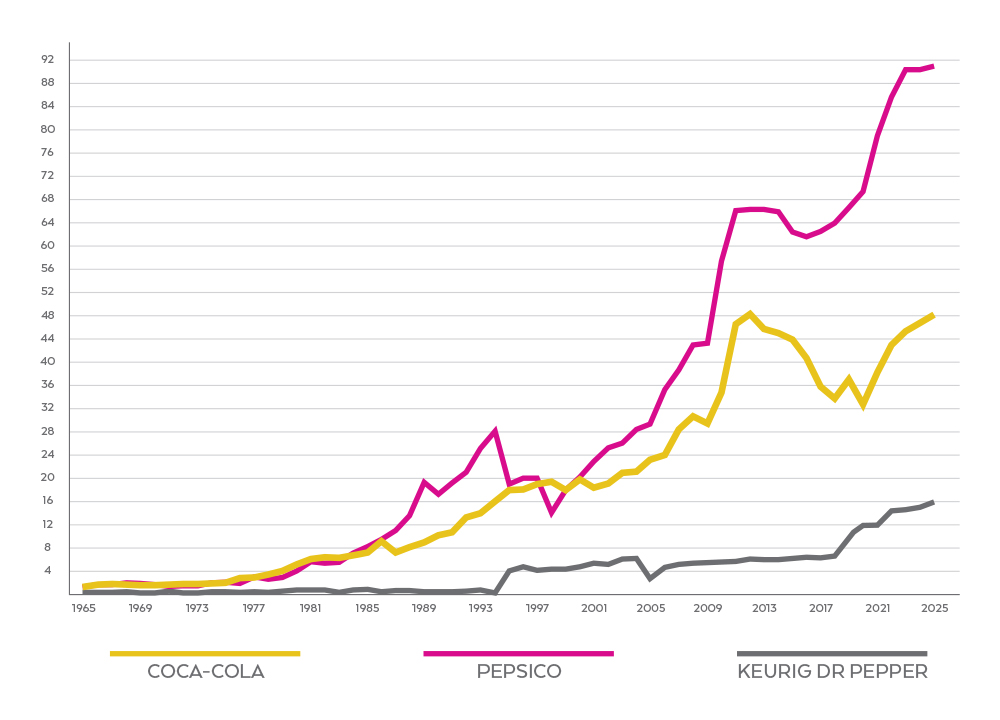
By 1977, sales of Dr Pepper had more than quintupled, and by 1983, Dr Pepper was the fourth most popular soft drink in the United States. But the company had grown too big too fast, and was on the brink of bankruptcy again. In 1984, Dr Pepper was purchased by an investment firm which changed the organization to a private company. In 1986, Dr Pepper was acquired by a different investment firm which merged it with Seven-Up. Cadbury Schweppes acquired the brand in 1995, and in 2008 created the Dr Pepper Snapple Group. In 2018, Dr Pepper merged with Keurig to become Keurig Dr Pepper, the current company entity. And, of course, in 2024, Dr Pepper became the second most popular soft drink in the United States, despite the fact that its revenues are less than one-third of Coke's, and less than one-sixth of Pepsi's.
ANNUAL REVENUE IN BILLIONS OF US DOLLARS
Coca-Cola had a much smoother path than Dr Pepper. It was created by John Pemberton one year after Dr Pepper in Jacobs' Pharmacy in Atlanta, Georgia. Pemberton's original creation was a wine that contained both alcohol and cocaine, but a prohibition law passed by Fulton County forced him to develop a non-alcoholic version of the beverage. Originally established as the Pemberton Chemical Company, the Coca-Cola Company was officially incorporated in 1888. In 1919, the company was purchased by an investment group that took the company public.
As a result of aggressive and innovative marketing tactics, Coca-Cola quickly became the most popular soft drink in the United States, and only wavered briefly in the 1980s. As Pepsi steadily gained in popularity and created taste-test challenges all over the country, Coke responded by replacing its 100-year-old formula with New Coke in 1985, and its market share plummeted. Within less than three months, the company resurrected the original formula as Coca-Cola Classic. The company rebounded by 1989, and New Coke was renamed Coke II in 1992, and completely discontinued in 2002.
By 2013, Coke had more than twice the market share of Pepsi, and has only increased the distance between the two brands. Over the years, Coca-Cola has acquired several brands, including Dasani, Fanta, and Sprite. It has grown to be the most profitable beverage company in the United States.
ANNUAL PROFIT IN BILLIONS OF US DOLLARS
Pepsi was created in 1893 in New Bern, North Carolina by Caleb Bradham. The product's original name was Brad's Drink. The name was changed to Pepsi-Cola in 1898, borrowing from the condition dyspepsia (indigestion) which the product claimed to cure. Coke had a seven-year lead on the new beverage, and Pepsi did everything it could to catch up. In 1902, Bradham incorporated the Pepsi-Cola Company.
In 1923, Pepsi went bankrupt, and was eventually purchased by Loft, Incorporated, a candy manufacturer and owner of soda fountains. Pepsi merged with Frito-Lay in 1965 and became PepsiCo, the public company that exists today. The company briefly owned Pizza Hut, Taco Bell, and KFC, but abandoned restaurants in 1997. It continued to acquire various brands, and by 2001 owned Mountain Dew, Aquafina, Cheetos, Doritos, Lay's, Ruffles, Tropicana, Quaker Oats, Lipton, Brisk, Gatorade, Rold Gold pretzels, and nearly 100 other products.
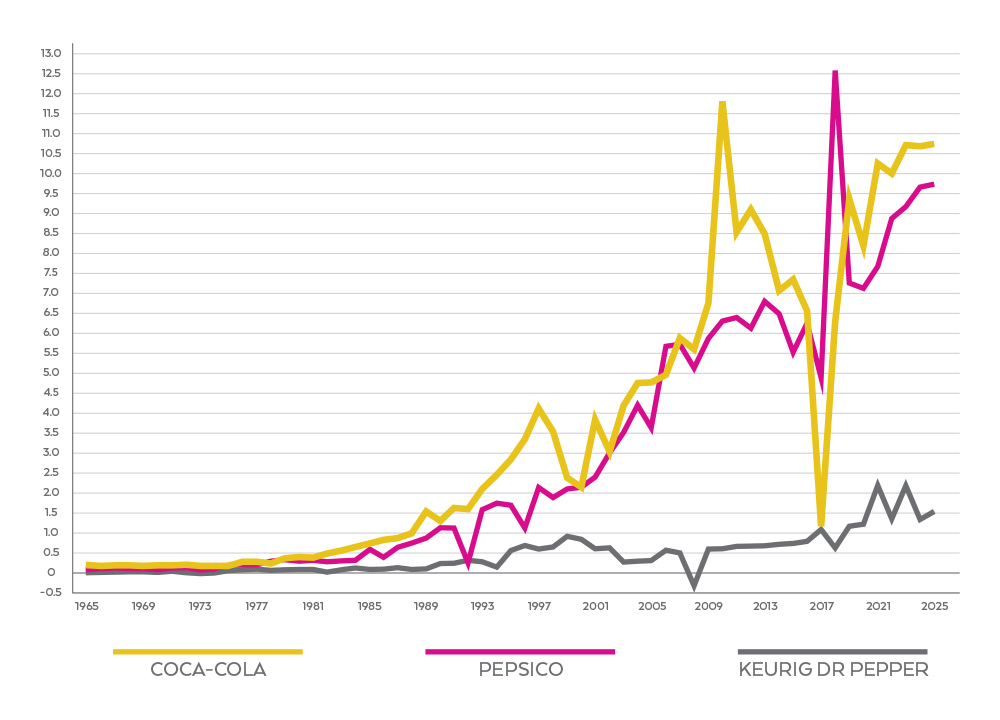
Last year, PepsiCo ranked the second largest food and beverage company in the world, behind only Nestlé. Coca-Cola was fourth, behind Anheuser-Busch. In 2000, PepsiCo's revenue crept past Coca-Cola's, and has continued to climb. Last year, its revenue was more than twice that of Coca-Cola's. PepsiCo's profits trail just behind Coca-Cola, but are trending upward. If the trend continues, PepsiCo will become more profitable than Coca-Cola in twenty years.
This year, Pepsi made news again when it fell to number four behind Sprite. News outlets called Pepsi's performance "humiliating" and "a remarkable fall." As a company, PepsiCo is still the number two beverage seller in the United States, and is incidentally the number one food and beverage seller in all of North America. And as a company, PepsiCo outsells Coke and Dr Pepper two-to-one and six-to-one, respectively. So respectfully, for all the hype and doomsday predictions, Pepsi is doing just fine.
SOURCES
- "Dr Pepper Just Passed Pepsi as the Second Biggest Soda Brand" from CNN
- "Pepsi Lost the Cola Wars to Coke. Why is It Struggling to Hold on to Second Place?" from the Guardian
- Soft Drinks: Their Origins and History by Colin Emmins
- "The Oldest Soda Pop in America Belongs to Vernor's" from Rural Media Group
- "The History of Dr Pepper: From Waco to Keurig Dr Pepper" from Texas State Historical Association
- "World’s First Coca-Cola was Served" from the Library of Congress
- "Down the Sink: New Coke" from Time
- "Here’s How Pepsi Really Got Its Name" from Reader's Digest
- "PepsiCo, Inc." from Encyclopaedia Britannica
- "The Global 2000" from Forbes
- "Pepsi Knocked Out of America's Top Three Sodas in Humiliating Shake-up" from the Daily Mail
- Market share data from Beverage Industry
- Revenue and earnings data from various annual reports
LISTEN

SUBSCRIBE


