

February 25, 2026
HOW DISNEY BECAME THE JUGGERNAUT
Walt Disney began his career as a commercial artist at age 18 in 1919. The next year, he opened his own commercial art studio, which failed in one month. Two years later, he incorporated his first animation company. That failed within a year. After two bankrupted business attempts, Disney moved to Hollywood and started a third business with his brother Roy. In 1928, he created Mickey Mouse and released the first cartoon with synchronized sound. In 1932, he created the first full-color cartoon. In 1937, he released Snow White and the Seven Dwarfs, the first feature-length animated film.
By 1940, Walt Disney had won 8 Academy Awards for Best Short Subject (Cartoon), plus two honorary awards for creating Mickey Mouse and Snow White and the Seven Dwarfs. But once again, his company was on the verge of bankruptcy. That was the year Disney became a public company and offered shares in an attempt to raise capital. So how did a faltering company with no track record in turning profits become one of the largest media empires in the world?
The stories of Walt Disney's business failings are well-documented, but his company's actual financials begin in 1940 when Walt Disney Productions released its first annual report. The year Disney went public, the company grossed $4.7 million and lost $1.3 million. Over the next nine years, Disney averaged an annual revenue of $5 million, but an annual profit of only $75,000. World War II had closed all foreign markets to entertainment and Walt Disney's management style had driven away most of his best creative staff. If the company had not been subsidized by the federal government for training films and propaganda cartoons, it would have become another bankruptcy for Walt Disney. Even with government assistance, Disney was suffocating under $4.5 million of debt.
Following Disney's financials, there are five key years which are triggered by five key business decisions that catapult the Disney organization to another level, usually doubling its revenues or profits. The first one occurs in 1950. Up until that time, Snow White and the Seven Dwarfs was Disney's only successful, feature-length animated film. Pinocchio, Fantasia, Dumbo, and Bambi had all failed to even recoup their production costs. But when Disney released Cinderella, the film connected with the American public in a visceral way. In the aftermath of a depression and a world war, the magical story of an underdog overcoming insurmountable odds provided a dose of optimism that the country was craving. And Disney never looked back. Over the next 75 years, Disney would only have three unprofitable years, and its revenues and profits would progressively increase by over a million percent. Cinderella made enough money to erase Disney's debt, pay dividends to its investors, and provide capital for the next phase of the company's history.
ANNUAL REVENUE AND EARNINGS IN MILLIONS OF DOLLARS
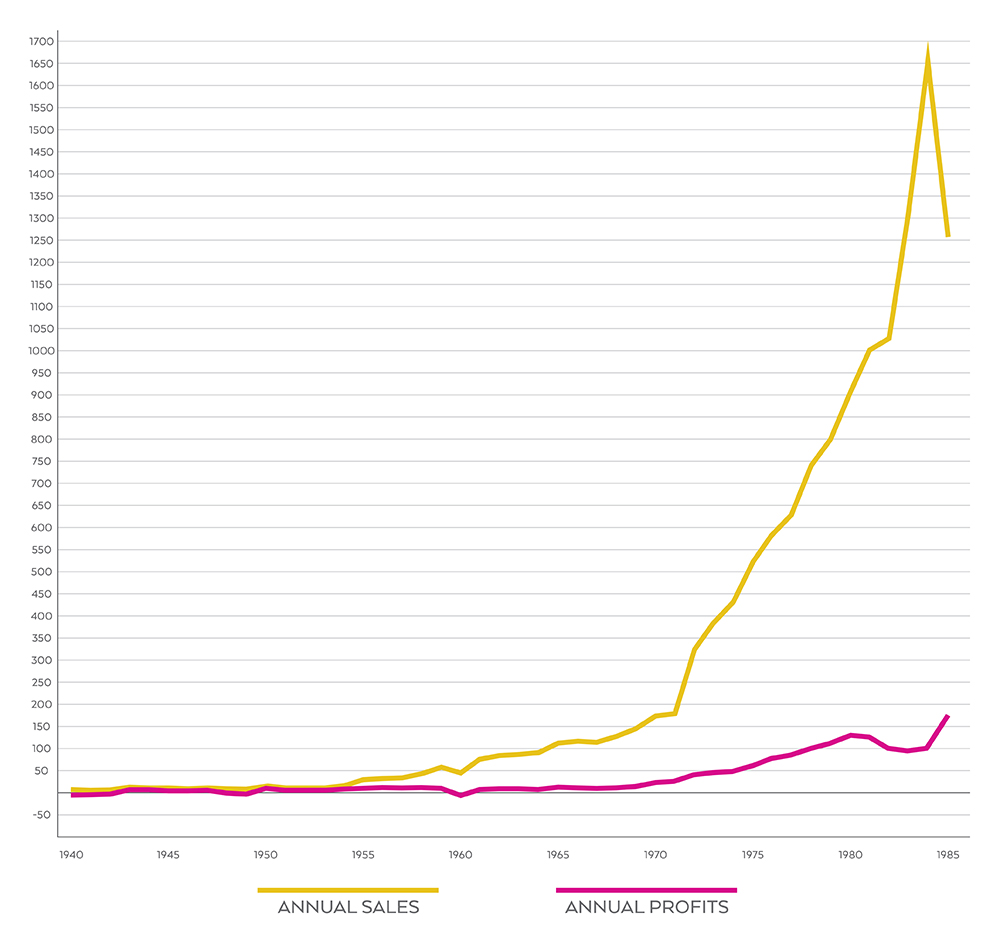
Five years later, that next phase became a reality. That year, Disneyland opened to the public. Walt Disney had dreamed of creating an amusement park that could be enjoyed by both children and adults since the 1930s. But historically, amusement parks had been dirty, shady enterprises where pickpockets, prostitutes, and drug dealers congregated. No one could envision Walt's description of a nonexistent theme park. The city of Burbank rejected the plan, and even when Anaheim agreed to the park's construction, the project was derisively dubbed "Walt's Folly," and was predicted to fail spectacularly. On July 17, 1955, the park opened to 5000 visitors during a live television broadcast to the entire country. But almost 30,000 people showed up with counterfeit tickets due to the excitement of the new park, and the grand opening was a grand disaster. Many attractions weren't open, there wasn't enough food and bathrooms to accommodate the crowds, and the asphalt paths weren't even dry enough for foot traffic. Newspapers declared the dire predictions were correct; Disneyland was an epic failure and was finished. But within two months, one million people visited the new park. Disneyland would not only add $16 billion and 100,000 jobs to Anaheim's economy, it would create the most popular vacation destination idea on earth.
After the opening of Disneyland, the company's revenues climbed into the hundreds of millions, and its profits into the tens of millions. The company created three different business segments in its reporting: film, television, and amusement park. In 1967, revenue from Disneyland and other entertainment activities surpassed film revenue for the first time. By 1971, the amusement park segment was renamed entertainment and recreation, and it accounted for 46% of Disney's revenue. On October 1, 1971, Disney opened its second park in Orlando, Florida for over 10,000 visitors. The next year, Disney doubled its revenue and profits, and entertainment accounted for 68% of all revenue. Four years later, in 1976, Walt Disney World welcomed its 50 millionth visitor. In 2024, Magic Kingdom was the most visited park in the world with 17.7 million guests. Disneyland was close behind at number two with 17.3 million visitors. In total, Disney's 12 theme parks around the world served over 140 million people. Its closest theme park competitor, Universal, had a total of 55 million international visitors.
The effects of the parks on Disney's revenues continued to impact the company through the next three decades. In 1981, Disney became a billion-dollar company. Its next phase of growth would be fueled by focusing on an older, underperforming segment of its business. In 1975, Disney added a new business segment, consumer products, focused on licensing and merchandizing its intellectual property. Consumer products never contributed more than $100 million to total revenue until 1987. The first Disney Store opened in March of that year in the Glendale Galleria in California. After that, the consumer products division almost doubled its revenue every year. In 1992, consumer products surpassed $1 billion, 14% of total revenue. In 1996, consumer products was redefined as creative content, and became Disney's leading division with over $10 billion in annual sales, 49% of total revenue.
ANNUAL REVENUE AND EARNINGS IN BILLIONS OF DOLLARS
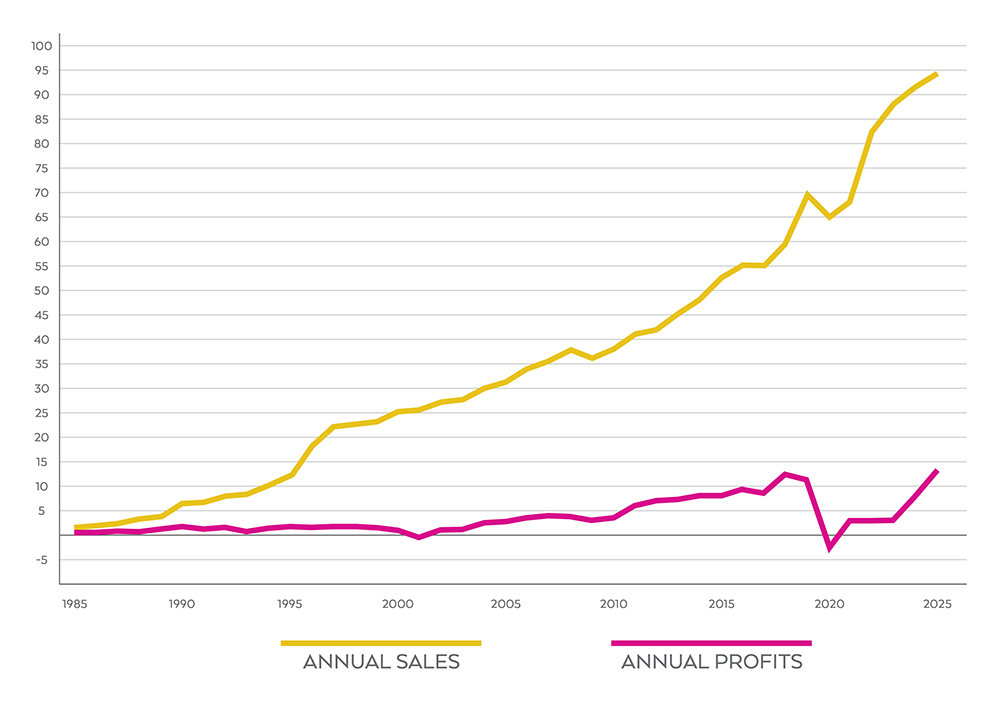
With the advent of the internet and online shopping, Disney closed 300 of its stores in 2006. That year, consumer products reported sales just under $2.5 billion, less than 10% of Disney's total revenue because the company had once again restructured its divisions. In 1999, Disney created a new division, media networks, undoubtedly after its acquisition of ABC in 1995. But it was more likely the result of the company's realization of the power of intellectual property, and a preparation for the company's next moves. Between 2006 and 2019, Disney would acquire Pixar, Marvel, Lucasfilm, and 21st Century Fox, along with all of their respective media and characters. The last of those completed the fragmented agreements of Marvel characters and literally made Disney the Juggernaut. During those acquisitions, Disney's revenue almost doubled, and its profits more than tripled, climbing beyond $10 billion. When media networks was established in 1999, its sales were $7.5 billion, 32% of total revenue. By 2022, the last year media networks was considered a division, it boasted $55 billion in sales, 66% of total revenue. But that same year, the profit generated from parks and experiences was almost twice that of media networks. So Disney reorganized again, and has now entered their newest phase of development.
Disney currently operates three business segments: entertainment, experiences, and sports. Entertainment encompasses Disney's theatrical and streaming releases. In 2023, it represented 45% of revenue, but only 11% of profit. Conversely, the experiences division, which includes parks and cruises, accounted for 36% of revenue, but 70% of profit. Disney's overall profit almost doubled between 2023 and 2024, and then more than doubled in 2025 to a company record $13.4 billion. Capitalizing on the current performance of its theme parks and cruises, Disney has announced a $60 billion investment to enhance its current 12 parks, add another in United Arab Emirates, and double its cruise fleet.
Walt Disney demonstrated a unique talent for both entertainment innovation and bankrupting businesses. But once his company succeeded enough to make some of his dreams a reality, the company never looked back. Through the vigorous creation and exploitation of its own intellectual property, along with key acquisitions of others' intellectual property, Disney has amassed what might be the most significant and impressive portfolio of characters and media the world has ever seen. And if anyone has figured out how to capitalize financially on all of that material, it's The Walt Disney Company.
SOURCES
- "Walt Disney Timeline" from The Walt Disney Family Museum
- "Celebrating 90 Years of The Walt Disney Company" from The Official Disney Fan Club
- "Disney Was in Distress During the Late 1940s. Then 'Cinderella' Came to the Rescue and Saved the Company From Financial Disaster" from Smithsonian
- "The California city that rejected Disneyland" from SFGATE
- "Disneyland Got Off to a Nightmare Start in 1955, but 'Walt's Folly' Quickly Won Over Fans" from the Los Angeles Times
- "Walt Disney Opens Florida Gates" from Lodi News-Sentinel
- "Walt Disney World Resort" from The Official Disney Fan Club
- "Popularity of the World's Leading Theme Parks Revealed in New Analysis" from Forbes
- "The Disney Store" from The Official Disney Fan Club
- "New Ownership Turns Disney Stores Around" from the Los Angeles Times
- "Disney's Spent 70 Years Funneling IP into Its Theme Parks. Here's Why It Works" from CNBC
- "Disney's Parks Are Its Top Money Maker - and It Plans to Spend $60 Billion to Keep It That Way" from CNBC
- Revenue data from Disney annual reports
LISTEN

SUBSCRIBE


