

September 24, 2025
IS MONEY MEANINGLESS?
Every few years, someone in the United States brings up the idea of returning the country to the gold standard. Most recently, a bill was introduced in the House of Representatives in 2023, and a call to return to a commodity-backed currency was published in the 2025 Mandate for Leadership. The argument is always that tying currencies to gold would control spending and inflation. J.P. Morgan is often quoted from his testimony before Congress in 1912, "Money is gold, and nothing else," to support the view that money without gold backing is meaningless. But the United States is not alone, because every single country in the world uses fiat currency, which is not backed by any commodity. Romanticized dreams of the gold standard aren't usually rooted in data, but money is big business, so let's look at the numbers.
CURRENCY, GOLD RESERVES AND GDP IN BILLIONS OF USD
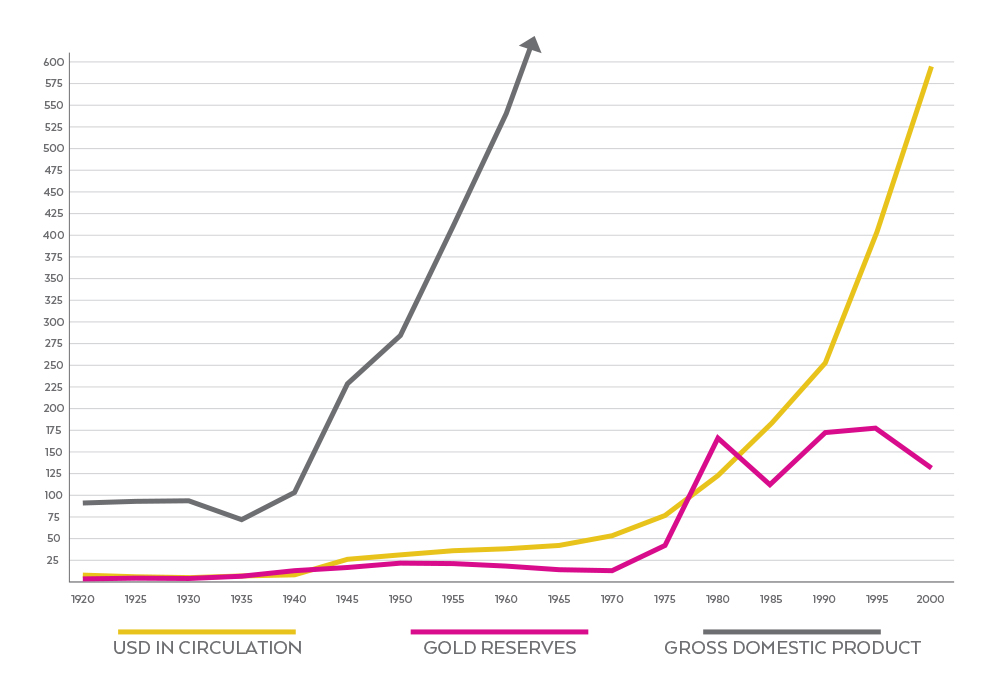
In 1971, President Richard Nixon ended the conversion of US dollars into gold, effectively ending the gold standard for the United States. Most people believe that prior to 1971, all US currency was backed by at least an equal amount of gold reserves. The fact is that the United States did not officially begin the gold standard until 1879, and at no time was there ever a law stating that the government or banks needed to maintain 100% of circulating currency in gold reserves. While the United States was legally on the gold standard, the country legitimately possessed enough gold to back the circulating currency for only nine years, from 1935 to 1944, only after Congress made it illegal for US citizens to possess gold. In 1934, Federal Reserve banks were required to hold enough gold to equal 40% of outstanding dollars. In 1945, that requirement was lowered to 25%, and in 1968 it was completely eliminated. So for most of the history of the US gold standard, gold was completely meaningless in relation to the US dollar, except that US citizens were not allowed to own gold until 1974.
The other major countries of the world followed a similar pattern to the United States with respect to gold, except almost all of them abandoned the gold standard by the 1930s. Some, like Belgium, Holland, China, and Mexico adopted a silver standard when gold was discovered in the United States, believing that an influx of gold into the global economy would only destabilize things. During the few decades while the world experimented with a true gold standard, it experienced the two worst global depressions in history.
While gold backing for US currency was short-lived and ineffective in controlling economic fluctuations, the gross domestic product (GDP) of the United States began growing rapidly after 1940 and became a much more steady indicator of economic strength. By the time the United States abandoned the gold standard, its GDP was 19 times more than its currency in circulation and 77 times greater than its gold deposits. And while GDP isn't a perfect measurement of a country's economy, it does provide an overview of the size and strength of an economy, and it's growth year over year indicates a strengthening economy overall. If a country can quantitatively demonstrate that it possesses the economic engine to support its currency, perhaps that is a more powerful backing for currency than an arbitrary value placed on a mined metal.
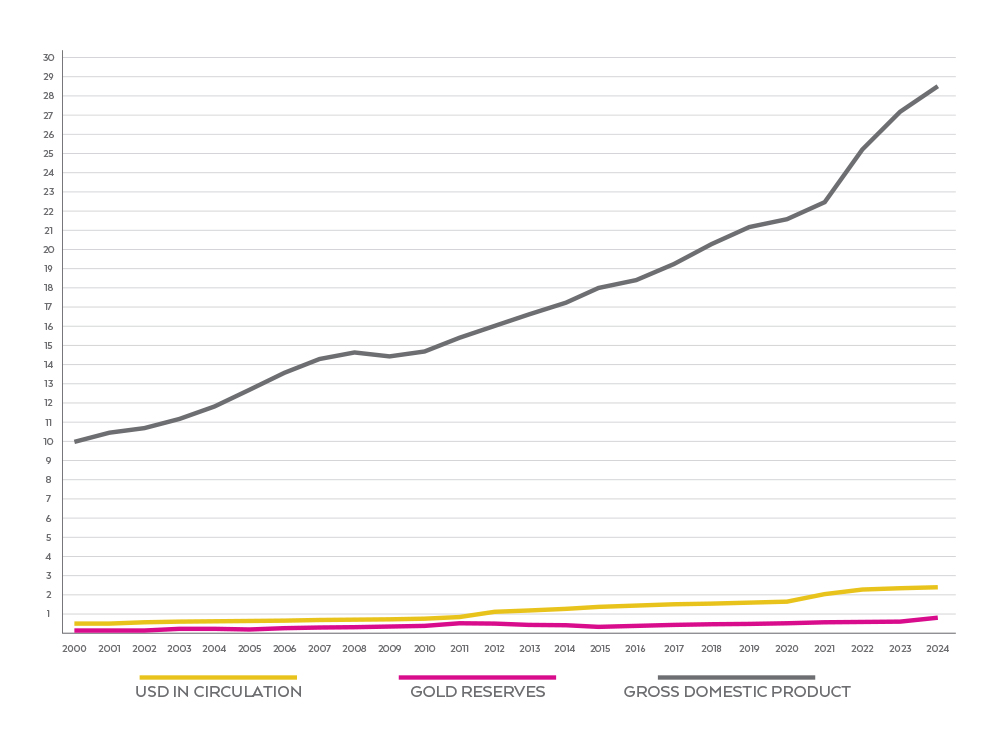
It's interesting to note that after the United States abandoned the gold standard, it experienced another sharp spike in GDP that has remained constant ever since. In addition, another two of the largest economies, Japan and the United Kingdom, also began growing at a similar rate at the same time. The same thing occurred for China and India in the mid 2000s. Those five countries - the United States, China, Japan, India, and the United Kingdom - are the largest economies with a unique currency so we can accurately compare currency and GDP. They also account for 55% of the entire world GDP.
CURRENCY, GOLD RESERVES AND GDP IN TRILLIONS OF US DOLLARS
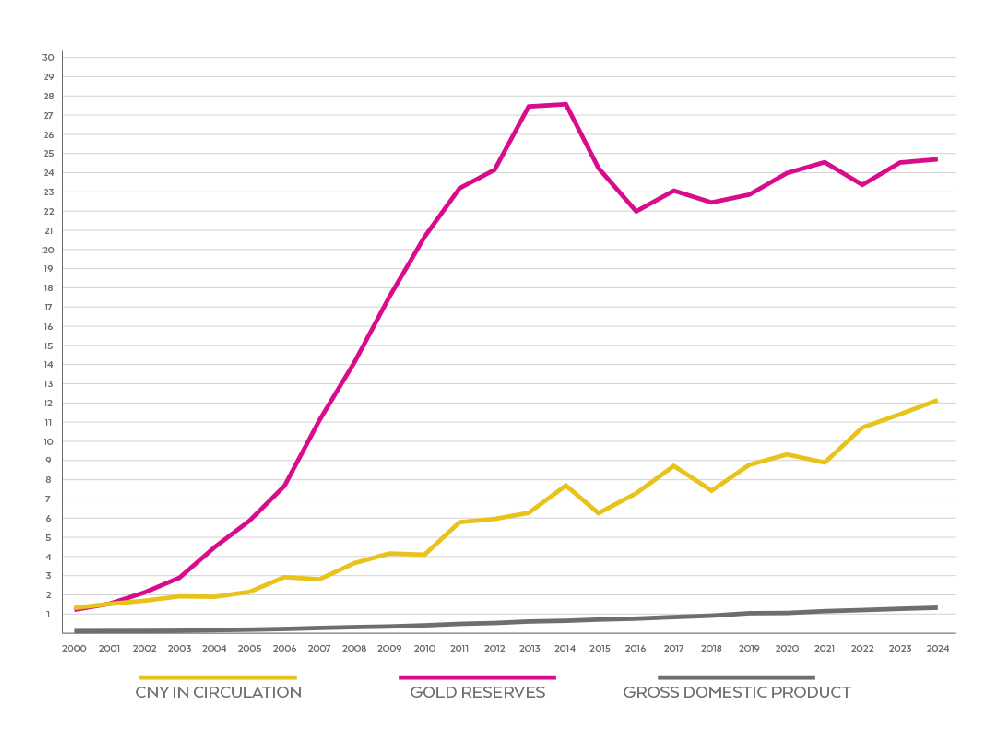
CURRENCY, GOLD RESERVES AND GDP IN TRILLIONS OF CHINESE YUAN
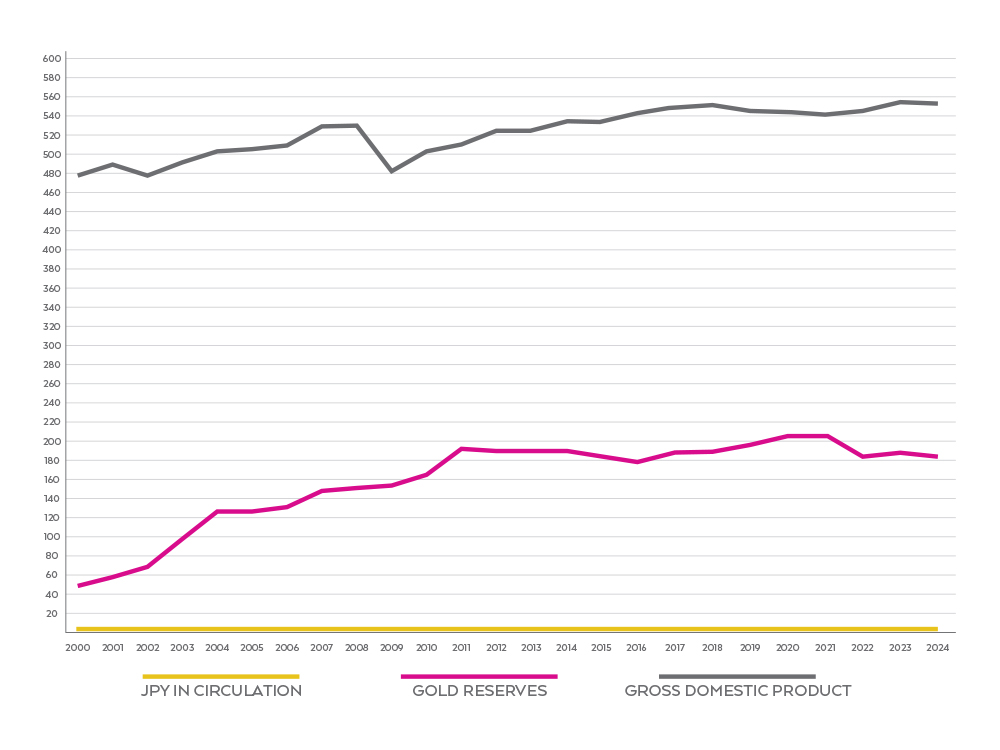
CURRENCY, GOLD RESERVES AND GDP IN TRILLIONS OF JAPANESE YEN
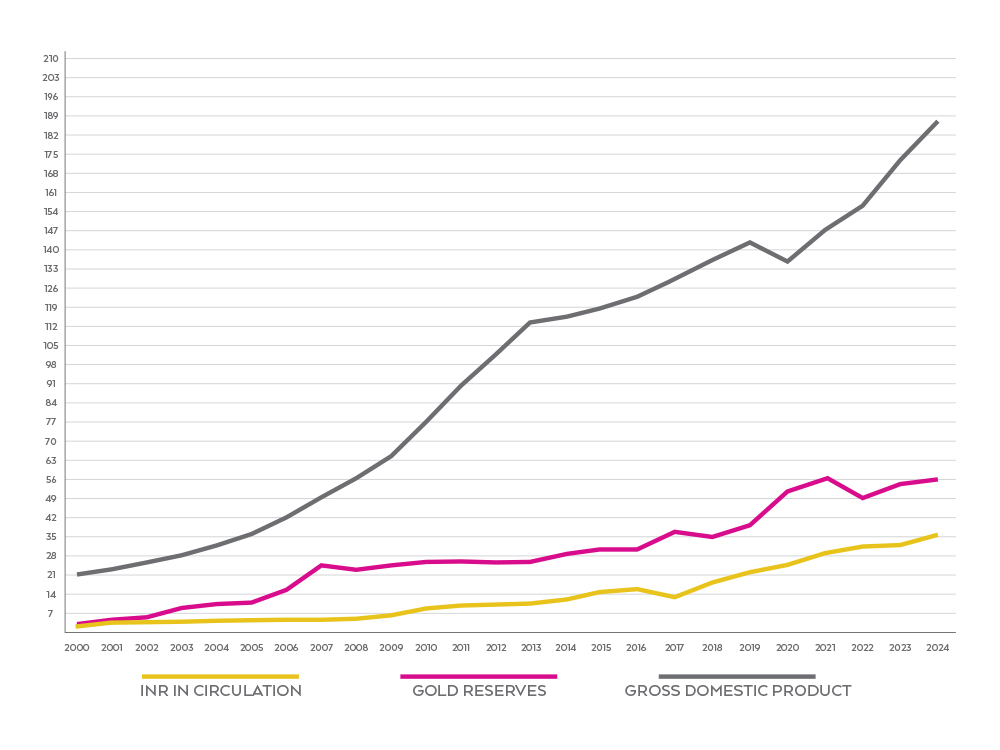
CURRENCY, GOLD RESERVES AND GDP IN TRILLIONS OF INDIAN RUPEES
CURRENCY, GOLD RESERVES AND GDP IN TRILLIONS OF BRITISH POUNDS
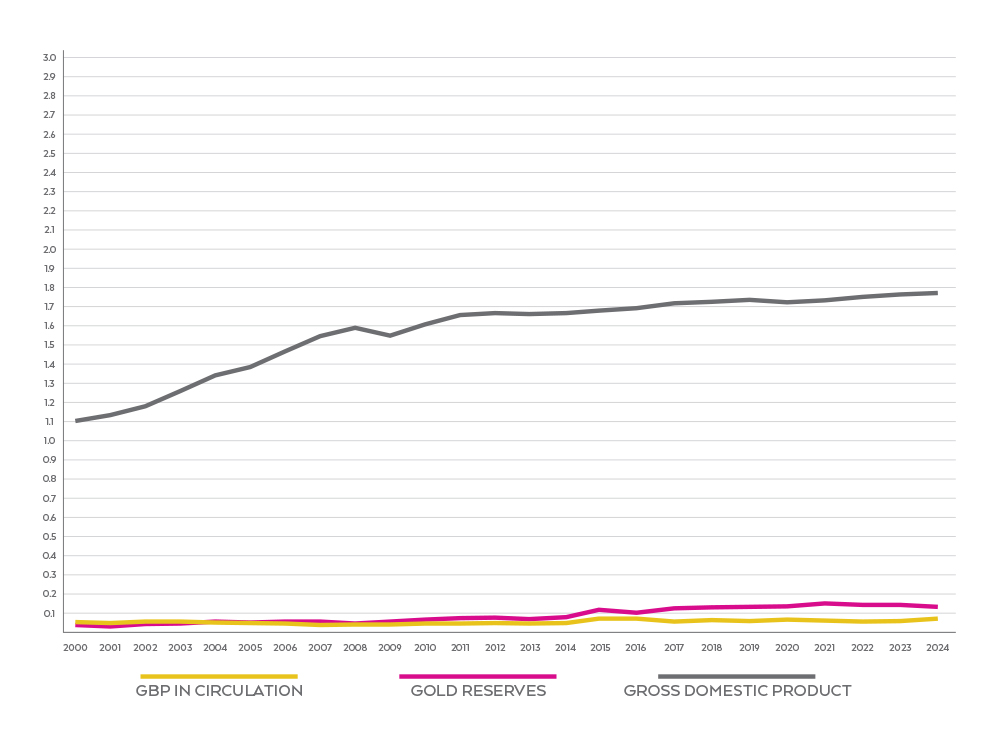
Comparing the five largest economies, excluding the European Union, over the past 25 years reveals several similarities. Every country except one has currency circulating far below the country's GDP. India has the greatest gap with a GDP that is over 5000 times greater than its circulating currency. Next is Japan with a GDP that is 470 times greater, then the UK with a GDP 36 times greater, then the US with 12 times the GDP. Only China has more currency in circulation than its annual gross product, and significantly more at nine times the amount.
But, while not adhering to a gold standard, China seems to be bolstering its currency by purchasing more gold than any other country. In fact, while the top five countries possess over 40% of all the gold reserves in the world, China owns more than the other four countries combined, over 200% of its available currency. Japan, India, and the UK have gold reserves over 150% of their currency. Only the US has more currency in circulation than its gold reserves, ironically maintaining 40% of its value in gold, which was the amount first required by Congress when it was on a gold standard.
Cumulatively, the top five economies nearly doubled over the past 25 years. According to the International Monetary Fund, the GDP of the wealthiest countries in the world increased sixfold during the 20th century, while the rest of the countries grew threefold. As a result, the per capita GDP of the poorest country now is higher than the that of the richest country in 1870. During the past 100 years the world GDP increased 19-fold, fueled by several technological and political developments, including the concept of fiat currency. The fact that the entire world is wealthier now than in all of human history is a reality that is based on more than just a hopeful belief in money. Child mortality, violence, and extreme poverty are all at the lowest levels they've ever been, while life expectancy, literacy, and per capita income are at their highest levels. Gold never accomplished that. Money did.
SOURCES
- "H.R.2435 - Gold Standard Restoration Act" from the 118th Congress
- "The Project 2025 Monetary Policy, Gold Standard and Federal Reserve" from University of Wisconsin
- "Testimony of J.P. Morgan Before the Bank and Currency Committee of the House of Representatives, at Washington, D.C." from the 62nd Congress
- "Nixon and the End of the Bretton Woods System, 1971–1973" from the Office of the Historian
- "The Gold Standard: Historical Facts and Future Prospects" from Harvard University
- "Public Law 93-373" from the 93rd Congress
- "Here's Why the U.S. No Longer Follows a Gold Standard" from the Federal Reserve Bank of St. Louis
- "What Is the Relationship Between Money Supply and GDP?" from Investopedia
- The World Economy in the Twentieth Century: Striking Developments and Policy Lessons from the International Monetary Fund
- "How the World is Healthier, Happier, and Wealthier than Ever – and What That Might Mean for Social Work" from Richard Devine
- United States Dollar circulation data from the Board of Governors of the Federal Reserve System
- United Kingdom Pound circulation data from the Bank of England
- Chinese Yuan circulation data from the People’s Bank of China
- Indian Rupee circulation data from the Reserve Bank of India
- Japanese Yen circulation data from the Bank of Japan
- United States GDP data from the Bureau of Economic Analysis
- United Kingdom GDP data from the Office for National Statistics
- China GDP data from the National Bureau of Statistics of China
- India GDP data from the Ministry of Statistics and Programme Implementation
- Japan GDP data from the Cabinet Office, Government of Japan
- United States gold reserves data from the National Bureau of Economic Research and The World Bank Group
- United Kingdom, China, India, and Japan gold reserves data from The World Bank Group
LISTEN

SUBSCRIBE


