

August 20, 2025
COVID DID NOT KILL THE MOVIE INDUSTRY
There's a classic, tragic story that the media loves to recount. A global pandemic forced us all into lockdown, and many businesses had to shut their doors, but no industry suffered more than movie theaters. Not only were theaters closed for months, but Hollywood studios followed Netflix's lead and embraced streaming in a way that crippled their own industry. It's a compelling, dramatic tale that has been documented by Cinema United, the national association for movie theaters, with data of decimated box office revenues. That data has been included in every annual report of AMC, the largest movie theater chain in the world, since 2020, not so subtly reminding its investors that an event beyond all control eternally altered its business model and revenues. Cinema United is a private organization and doesn't release the methodology for its data, plus it possesses an obvious conflict of interest. Luckily, five studios account for over 80% of all movie ticket revenues, and three theater chains account for 50% of those same revenues, and they're all public companies with published annual data. So let's see if the facts match the story.
BOX OFFICE REVENUES IN BILLIONS OF US DOLLARS
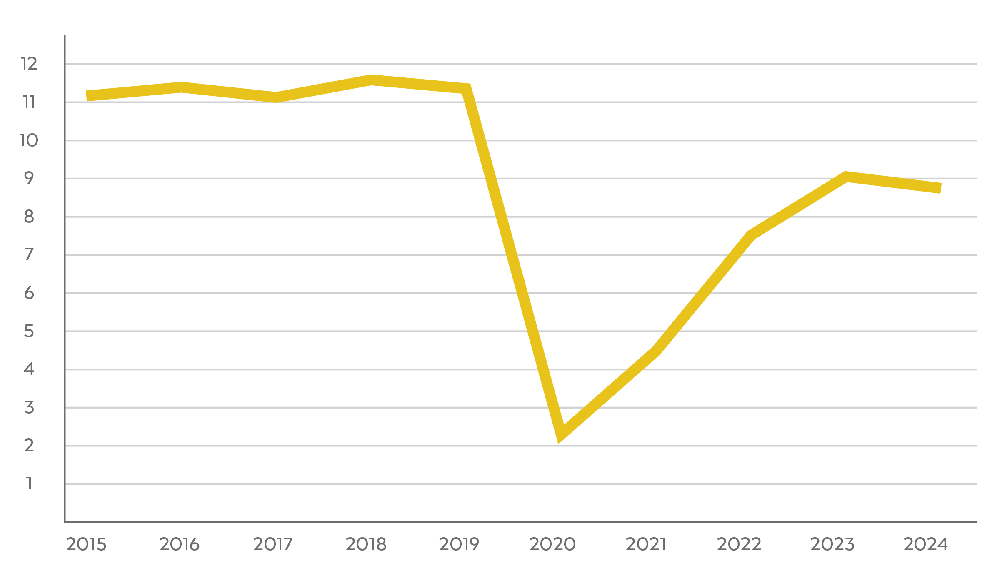
According to Cinema United, revenues of movie theaters in the United States were consistently over $11 billion each year since 2015. Then in 2020, amid mandated closures and less available films to show, the national revenues of all theaters were cut by 80%. In the aftermath, those revenues never recovered. As stated earlier, Cinema United doesn't reveal sources for these figures, and there are several reasons to doubt their veracity. First, the statistics provided are apparently based on ticket sales in only the United States, while every company we will investigate operates internationally. Second, as such, the data lists 2018 as the year with the highest recorded revenue, but not a single top movie studio or theater lists that year as their best. Because third, 2019 was a record year both internationally and for individual movies, seeing the highest grossing movie of all time and the most movies to gross over $1 billion. Fourth, the three largest theater chains reported a significant increase in revenues from 2015 to a record year in 2019, not a relatively consistent trend before the pandemic. And fifth, every major theater chain and all but two of the largest movie studios not only reported a recovery in revenues by 2024 to levels similar to those in 2015, but most of them have surpassed 2015 levels.
Granted, none of the following statistics address profit levels, which may reveal the exact effect and outcome that Cinema United is trying to communicate. But Cinema United explicitly quotes revenues in its data, so we are only considering reported revenues for the companies we've chosen. And while these companies don't represent the entire movie industry, they account for most of it, and especially with respect to the top three theater chains which all show very similar trends, the data seems to indicate a consistent and very different story than the one that Cinema United keeps telling. Here are the quantifiable numbers.
TOP FILM STUDIO REVENUES IN BILLIONS OF US DOLLARS
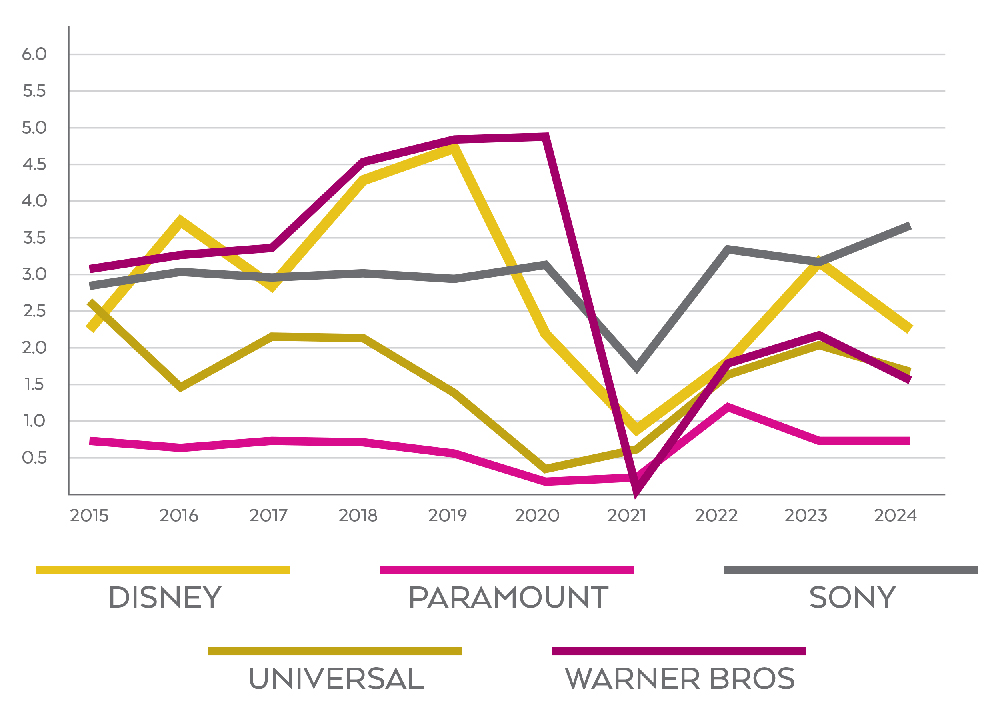
Walt Disney Studios, Paramount Pictures, Sony Pictures, Universal Pictures, and Warner Brothers Pictures grossed just under $12 billion in revenue from theater-released films in 2015. They peaked in the record year of 2019 with $14.5 billion. Due to their reporting structure and timing, every studio had its worst year of revenue in either 2020 or 2021 due to the COVID pandemic, and 2021 was the lowest combined revenue of the five studios at just over $3.5 billion. By 2024, only Universal and Warner Brothers reported revenues below their levels in 2015, and the combined revenue of the studios was just over $10 billion.
TOP MOVIE THEATER REVENUES IN BILLIONS OF US DOLLARS
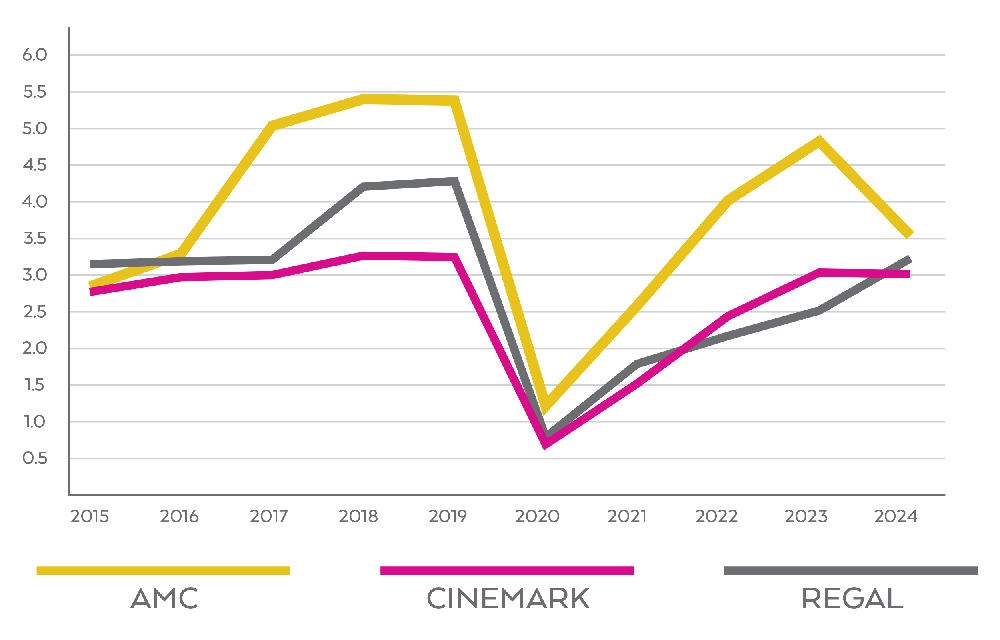
AMC Theatres, Regal Cinemas, and Cinemark Theatres grossed just under $9 billion in 2015, which again represents just over half of all movie theater revenues. This is exceedingly more than reported by Cinema United because, while movie theaters make most of their revenue from ticket sales, they also sell concessions and advertising, which are far more profitable for them. In 2019, the real record year for the movie industry, the top three theater chains made just over $13 billion. Their lowest combined revenue occurred in 2020 with under $3 billion. And in 2024, all three surpassed their 2015 revenues for a total of just under $10 billion.
Understandably, these figures are indicative of the largest entities in the industry, and may not represent the performance of smaller studios and theaters. But they do account for the majority of the revenues that Cinema United is calculating. While movie ticket sales in the United States may be declining, one can hardly argue that the movie industry has been suffering decreased revenues since the pandemic. But one can certainly argue that entertainment viewing has changed since the pandemic, and that behavior may be contributing to empty theaters. That's the second part of the Cinema United argument - the bane of streaming initiated by the pandemic. But is the rise of streaming related to the pandemic, or is its rise simply coincidental in timing with it?
STREAMING PLATFORM REVENUES IN BILLIONS OF US DOLLARS
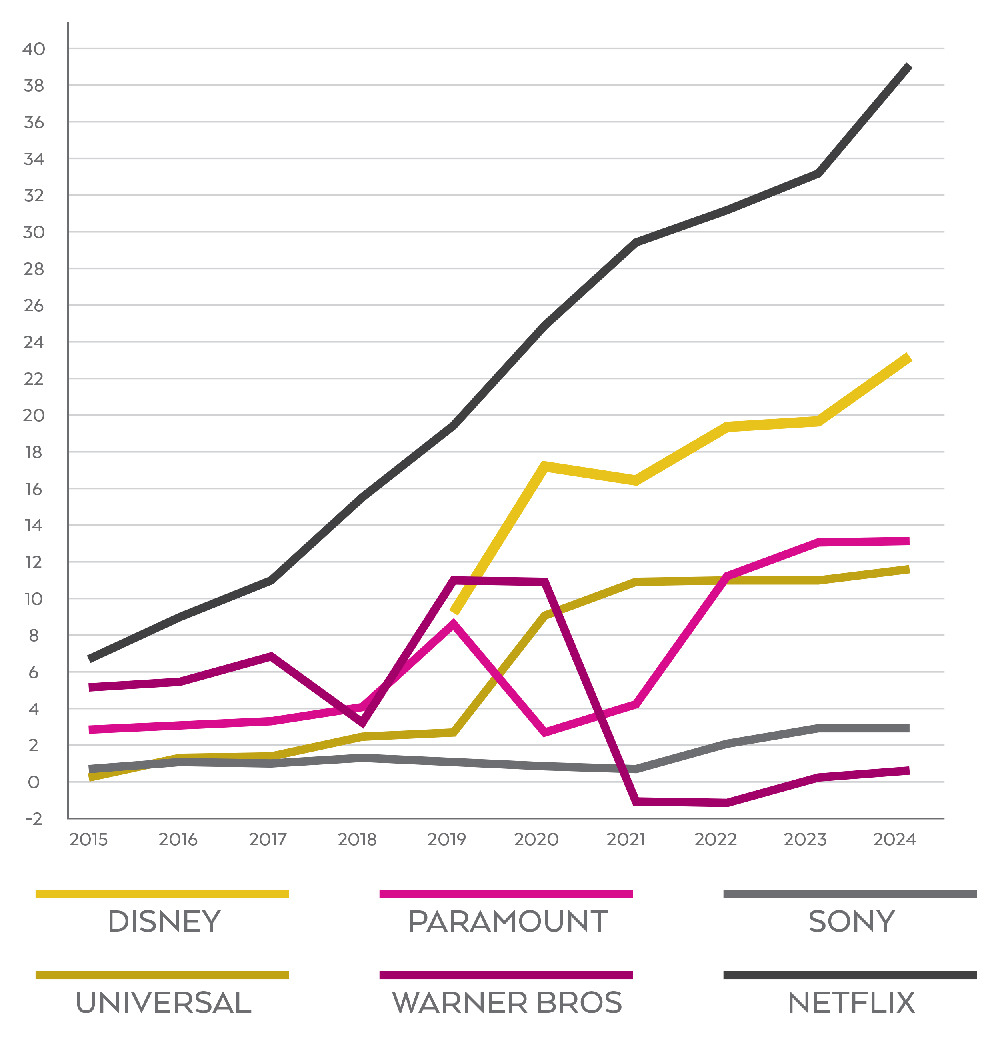
In 2015, every major studio except Disney already had a streaming solution. Universal originally only collected licensing fees from other streaming services for its content. Sony provided streaming through its Playstation game systems and Bravia televisions. CBS All Access was inherited by Paramount when it merged with CBS in 2019. Warner Brothers owned HBO, which was the original subscription television service. Late to the game, Disney+ was launched in 2019, so all five major film companies had established streaming platforms before the pandemic hit. By 2021, the current iterations of streaming services were established by the top five movie studios as Disney+, Paramount+, Peacock, HBO Max, and Sony Pictures Core. In 2015, leading streamer Netflix revenues were 21% higher than the next highest performing streaming service. By 2024, Netflix was 71% higher than the next closest service. In 2015, the top five film studios and Netflix amounted to over $17 billion in streaming revenue, already greater than the film revenues that same year by over $5 billion. In 2024, the same companies reported a combined gross revenue of just over $90 billion, nine times the amount that cinema films grossed.
Again, none of this says anything about company profits. We have looked at several companies on this show that demonstrated diminishing profits when revenues increased, like Kodak, the United States Postal Service, and the Olympics. I don't doubt that the movie industry has been changing and becoming more difficult to turn a profit, both in the production and the presentation. But that's not the argument Cinema United, its member theaters, and the media keep making. Movie studios and theaters struggling to be profitable puts the blame on those companies. Arguing that revenues keep declining puts the blame on consumers, and that's just not what the data reveals. Culture constantly changes, technology constantly evolves, and companies rise and fall in a free marketplace. It does no favors to anyone, and is statistically dishonest, to spin incomplete data to tell a convenient, albeit incomplete, story.
In 2023, streaming outperformed both broadcast and cable television for the first time according to Nielsen, and its analysis never mentioned the pandemic. By 2025, streaming accounted for 45% of all television viewing. Movie theaters are not a victim of pandemic restrictions and a streaming landscape that was erroneously bolstered by the film industry. Streaming was an inevitable certainty well before 2019. Overall revenues and viewership are higher now than they have ever been in the history of the movie industry. The landscape has just changed, and not because of COVID. Streaming revenues didn't make a sharp rise in 2020 when the studio and theater revenues plummeted. They kept climbing at a very similar rate. All the trends seem to indicate that this is where movie entertainment was going to be whether we had a pandemic or not. COVID wasn't a catalyst; it was just a blip in an already new entertainment paradigm.
SOURCES
- "Five Years Ago, the Pandemic Shut Down Movie Theaters - and They Never Fully Recovered" from SlashFilm
- "Ranking of Movie Studios in the United States as of July 2024, by Domestic Market Share of Ticket Sales" from Statista
- "Leading Cinema Circuits in the United States and Canada as of March 2023, by Number of Screens" from Statista
- "2019 Global Box Office Revenue Hit Record $42.5B Despite 4 Percent Dip in U.S." from The Hollywood Reporter
- "Movie Theater Economics: If You Love Cinemas, Buy the Damn Popcorn" from Big Think
- "Streaming Grabs a Record 38.7% of Total TV Usage in July, with Acquired Titles Outpacing New Originals" from Nielsen
- "Streaming Reaches Historic TV Milestone, Eclipses Combined Broadcast and Cable Viewing for First Time" from Nielsen
- Revenue data from various annual reports
LISTEN

SUBSCRIBE


